/ Jun 27, 2026
Trending

The modern university experience is often described as a balancing act, but for many undergraduate students, it feels more like a high-wire performance in a windstorm. Between the pressure of maintaining a high GPA, navigating social shifts, and preparing for an uncertain job market, academic stress has become a quiet epidemic. However, the root of this stress isn’t always the volume of work; often, it is the friction we encounter during the creative process. When the words won’t flow and the structure feels weak, the psychological burden doubles.
Finding a personal rhythm in academic writing is the first step toward reclaiming your mental space. For many, the hardest part of any assignment is simply the blank page. This is where shifting from a rigid, formal mindset to a more exploratory one can make a difference. If you are struggling to find a spark for your next project, looking through a diverse list of informal essay topics can help lower the stakes and allow your natural voice to emerge. By practicing with less “high-stakes” content, you build the muscle memory needed for complex research papers, effectively reducing the anxiety associated with starting from scratch.
To solve the stress crisis, we have to understand what it looks like. Burnout isn’t just being tired; it’s a state of emotional, physical, and mental exhaustion caused by excessive and prolonged stress. In the context of a student’s life, it usually manifests when the “output” required exceeds the “input” of rest and inspiration.
| Phase of Stress | Common Symptoms | Impact on Writing |
| Initial Overload | Procrastination, disrupted sleep | Frequent “writer’s block” |
| The “Wall” | Irritability, loss of motivation | Neglecting citations and structure |
| Full Burnout | Physical illness, chronic dread | Inability to complete assignments |
Breaking this cycle requires a two-pronged approach: managing your internal environment (mindset) and optimizing your external tools (resources).
In an era where digital shortcuts are everywhere, the value of a “human” voice has skyrocketed. Professors and admissions boards aren’t just looking for correct facts; they are looking for a unique perspective. Your voice is your academic thumbprint. When you write with a global tone—one that is clear, inclusive, and direct—you make your ideas accessible to a wider audience, which is a key skill in our interconnected world.
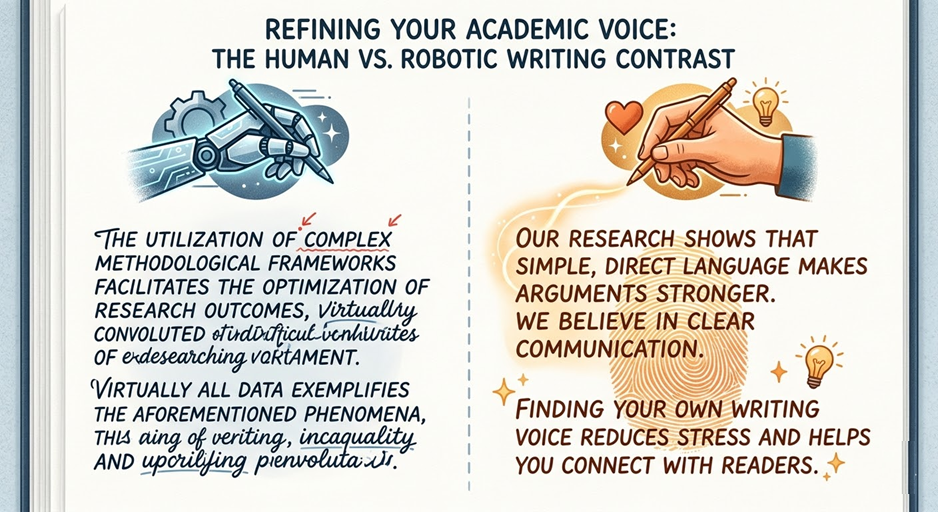
Refining your voice means stripping away the “academic fluff.” Many students think that using long, complex words makes them sound smarter. In reality, it often hides the lack of a clear argument. True expertise is the ability to explain a complex concept simply.
As you move through the middle of your semester, the complexity of assignments usually peaks. You might have the research and the voice, but the technical execution—the grammar, the referencing style (APA, MLA, Harvard), and the logical flow—can become overwhelming. This is the point where most students experience the “Middle-Semester Slump.”
To maintain your momentum and ensure your hard work doesn’t go to waste due to technical errors, many students find that professional essay editing services provided by experts at Myassignmenthelp offer the necessary safety net. Having an expert eye review your work doesn’t just “fix” mistakes; it provides a roadmap of where your logic might be tripping up, allowing you to learn and improve for the next submission. This transition from a rough draft to a polished masterpiece is where the most significant reduction in stress occurs, as it replaces “hope” with “certainty.”
Whether you are studying in London, New York, Sydney, or Mumbai, the clock ticks the same way. The most successful students are not the ones who spend 20 hours in the library, but the ones who use “Deep Work” phases.
Why does the “Final Polish” matter so much? In the professional world, your writing is often the first impression you make. A resume with a typo or a report with inconsistent formatting can suggest a lack of attention to detail. By treating your university assignments as a training ground for professional excellence, you change the narrative from “I have to do this for a grade” to “I am building my professional brand.”
Final polishing involves checking for:
Academic life should be a season of growth, not a season of suffering. By utilizing the right resources—whether that’s a creative list of topics to get you started or a professional editing team to help you cross the finish line—you are not “taking a shortcut.” You are managing your resources effectively.
Stress is inevitable, but being overwhelmed is a choice. When you approach your studies with a clear strategy, a refined voice, and a commitment to quality, you don’t just survive university—you thrive.
1. How do I know if I’m experiencing academic burnout?
If you find that tasks which used to take an hour now take four, or if you feel a sense of dread when opening your laptop, you are likely in the early stages of burnout. Taking a 24-hour total break from screens is often the best immediate remedy.
2. Is it okay to use an editing service for my university essays?
Yes, using an editing service is a standard practice for many students and researchers. It functions similarly to how an author works with an editor at a publishing house; it ensures your ideas are presented clearly, professionally, and without technical errors.
3. How can I make my writing sound more “human” and less robotic?
Focus on active verbs rather than passive ones. Instead of saying “The experiment was performed by the team,” say “Our team performed the experiment.” Also, avoid “filler” words like actually, basically, or virtually.
4. What is the most effective way to improve my GPA quickly?
The fastest way to see a jump in grades is to focus on the “Presentation and Polish” of your work. Many students lose 10-15% of their marks on simple formatting and grammatical errors that could easily be caught during a final review.
5. How do I choose a good essay topic when I feel stuck?
Start by looking at broader categories that interest you in daily life—like technology, social media, or travel—and then narrow them down. Using a resource for informal topics is a great way to “warm up” your brain before tackling heavy academic subjects.